Recent results
- L
- W
- W
- W
- W
- W





Roster
| No. | Player | Pos | Age | Ht | Wt | Exp |
|---|---|---|---|---|---|---|
| 0 |  Luguentz Dort |
G | 27 | 6' 4" | 220 lbs | 8 |
| 00 |  Keshon Gilbert |
G | 23 | 6' 4" | 200 lbs | 2 |
| 1 |  Jalen Johnson |
F | 24 | 6' 8" | 219 lbs | 6 |
| 2 |  Aaron Wiggins |
G | 27 | 6' 5" | 190 lbs | 6 |
| 3 |  CJ McCollum |
G | 35 | 6' 3" | 190 lbs | 14 |
| 4 |  Kingston Flemings |
G | 19 | 6' 3" | 183 lbs | R |
| 5 |  Dyson Daniels |
G | 23 | 6' 7" | 199 lbs | 5 |
| 7 |  Nickeil Alexander-Walker |
G | 28 | 6' 5" | 205 lbs | 8 |
| 8 |  Dorian Finney-Smith |
F | 33 | 6' 7" | 220 lbs | 11 |
| 10 |  RayJ Dennis |
G | 25 | 6' 2" | 180 lbs | 3 |
| 13 |  Henri Veesaar Out |
C | 22 | 7' 0" | 227 lbs | R |
| 14 |  Asa Newell |
F | 21 | 6' 11" | 224 lbs | 2 |
| 17 |  Onyeka Okongwu |
F | 25 | 6' 10" | 240 lbs | 7 |
| 18 |  Mouhamed Gueye Out |
F | 23 | 6' 11" | 210 lbs | 4 |
| 20 |  Zuby Ejiofor |
F | 22 | 6' 8" | 245 lbs | R |
| 22 |  Jalen Wilson |
F | 25 | 6' 6" | 220 lbs | 4 |
| 24 |  Corey Kispert |
F | 27 | 6' 6" | 224 lbs | 6 |
| 31 |  Jock Landale |
C | 30 | 6' 11" | 255 lbs | 6 |
Upcoming games




Injuries
-
Mouhamed Gueye Hawks · Foot · Fracture
Out -
Henri Veesaar Hawks · Knee
Out
About the Atlanta Hawks
The Atlanta Hawks are a cornerstone franchise of the NBA’s Eastern Conference, known for a long, eventful history, a loyal fan base, and a modern chapter centered at State Farm Arena in downtown Atlanta. With Quin Snyder guiding the current group and a roster that blends established production with fresh upside, the Hawks enter the season with a chance to build on a solid 46-win campaign.
Franchise history
The Hawks’ story stretches across multiple cities and names, making them one of the league’s more traveled and resilient franchises. The team was founded in 1946 as the Buffalo Bisons, later becoming the Tri-Cities Blackhawks, then moving through Milwaukee and St. Louis before settling in Atlanta. That path gives the franchise a distinctive identity: a team with deep roots, a series of reinventions, and a history that predates its current Southern home by decades.
In Atlanta, the Hawks have long represented a bridge between old-school NBA tradition and a modern market with major basketball energy. Their history includes memorable eras, several generations of standout players, and enough competitive cycles to make the franchise feel familiar to long-time NBA observers. While the Hawks have often been defined by reinvention, they have also remained a consistent part of the league’s fabric, with a brand that has endured through relocations, roster changes, and shifting conference landscapes.
Early foundations and relocations
Before becoming an Atlanta institution, the franchise passed through Buffalo, the Tri-Cities area, Milwaukee, and St. Louis. Each stop left an imprint on the team’s identity, but the St. Louis years remain especially important in the broader franchise timeline, both for competitive success and for the establishment of the Hawks as a legitimate NBA presence.
The move to Atlanta gave the organization a permanent home in one of the country’s most important basketball cities. Since then, the Hawks have been a visible part of the league’s East Coast competition, with alternating stretches of rebuilding and playoff relevance. That up-and-down history is part of what makes the franchise compelling: there is always a sense that a new chapter could arrive quickly.
The St. Louis championship era
The Hawks won an NBA championship in 1958, during their St. Louis era. That title remains one of the defining achievements in franchise history and the clearest marker of the team’s early place among the league’s elite. It is also a reminder that the Hawks’ legacy began well before their move to Atlanta.
The championship era helped establish the franchise’s historic credibility. Even as the team has gone through many changes since then, that title still anchors the Hawks’ all-time story and gives the organization a championship pedigree that spans generations.
Atlanta eras and modern identity
In Atlanta, the Hawks have cycled through different identities, from hard-nosed veteran groups to athletic, fast-moving teams built around young talent. Some seasons have brought deep playoff runs and others have centered on development, but the franchise has rarely lacked for intrigue. The team’s long-term narrative often revolves around finding the right blend of skill, length, shot creation, and defensive commitment.
That search continues today. The current Hawks are part of a familiar Atlanta basketball pattern: a team with enough talent to matter, enough youth to evolve, and enough recent success to expect more. The challenge is no longer just getting noticed; it is turning regular-season promise into something more durable in the spring.
Championships and legends
The Hawks’ trophy case is not built on volume, but on significance. The franchise has one NBA championship season in 1958, won during the St. Louis era, and that title remains central to the team’s identity. Beyond the championship itself, the Hawks have produced a rich lineage of stars, Hall of Famers, and era-defining contributors who helped shape the franchise’s reputation.
Several names stand out when discussing the Hawks’ all-time story. Bob Pettit is the franchise’s most iconic early star and one of the greatest players in team history. Later eras featured talented scorers, frontcourt anchors, and guards who kept the team relevant across different periods. The Hawks have also been home to players whose impact extended beyond statistics, helping define how the franchise was perceived in different generations.
- 1958 — NBA championship season in St. Louis
- Bob Pettit — the signature legend of the early franchise era and a foundational Hall of Fame figure
- Dominique Wilkins — the face of one of Atlanta’s most famous and popular eras
- Pistol Pete Maravich — a classic name in the franchise’s historical lineage
- Al Horford — a key modern-era frontcourt presence for Atlanta
- Joe Johnson — a leading scorer and centerpiece during an important Atlanta run
- Hall of Fame legacy — the franchise history includes several enshrined greats and enduring team icons
For many fans, the Hawks’ most memorable identity comes from the Dominique Wilkins years, when Atlanta basketball had a clear star and a strong emotional connection to the city. That era, along with the earlier championship foundation, gives the franchise a layered history that reaches well beyond any single season.
Home arena and city
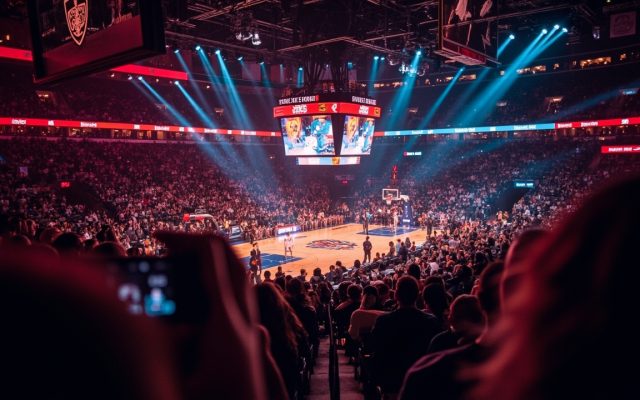
The Hawks play at State Farm Arena in Atlanta, a downtown venue that sits at the center of the team’s modern identity. The arena gives the franchise a high-profile home in a major sports city, and it has become one of the most recognizable basketball buildings in the Southeast. For the Hawks, home-court energy matters: the building is not only where games are played, but where the team’s current era is presented to the city.
Atlanta itself is a significant part of the Hawks’ brand. The city has a strong basketball culture, a large regional footprint, and a fan base that follows the team closely through both promising and difficult stretches. Being in the Eastern Conference also keeps the Hawks tied to a crowded competitive landscape, which only increases the importance of a strong home presence and a clearly defined team identity.
The combination of an urban arena setting and a nationally relevant basketball market gives the Hawks a platform that many teams would envy. State Farm Arena is not just a venue; it is the stage on which the franchise’s next competitive chapter must take shape.
Last season
Atlanta’s 2025-26 regular season was a successful one by recent standards, finishing 46-36 and reaching the playoffs. That record suggests a club that was competitive for much of the year and good enough to secure a meaningful postseason berth. For a franchise that has often measured progress by whether it can move from promise to stability, a 46-win season is an important marker.
The postseason, however, brought a difficult ending. The Hawks finished 2-4 in the playoffs and exited in the East’s first round after Game 6 against the New York Knicks, a 89-140 loss. The lopsided final result stands in contrast to the otherwise respectable regular season and highlights the gap the team still has to close if it wants to turn a good year into a deeper run.
That mix of accomplishment and frustration is central to evaluating the franchise right now. The Hawks proved they could win enough games to be taken seriously over the long haul, but the playoffs reinforced how important depth, consistency, and adaptability are when the stakes rise. For Atlanta, last season was both a step forward and a reminder that the next leap is the hardest one.
Current roster and coaching staff
Quin Snyder is the current head coach, and the roster around him has a wide range of experience levels, skill sets, and developmental timelines. The list includes established scorers, multi-position contributors, young players with upside, and several rookies who could help shape the team’s longer-term future. That blend creates both opportunity and uncertainty, which is often the story of a roster trying to convert talent into consistent production.
What stands out most is the variety of roles. Atlanta has creators, rebounders, perimeter defenders, shooters, and developmental pieces all in the same group. The challenge for Snyder is to create cohesion from that mix while getting reliable minutes from the players most capable of carrying nightly responsibility. The Hawks’ season could be shaped as much by rotation clarity as by raw talent.
- Quin Snyder — head coach
- Jalen Johnson — F, #1, age 24, 6 yrs exp; last season: 22.5 ppg, 10.3 rpg, 7.9 apg
- Nickeil Alexander-Walker — G, #7, age 28, 8 yrs exp; last season: 20.8 ppg, 3.4 rpg, 3.7 apg
- CJ McCollum — G, #3, age 35, 14 yrs exp; last season: 18.7 ppg, 3.3 rpg, 3.9 apg
- Onyeka Okongwu — F, #17, age 25, 7 yrs exp; last season: 15.2 ppg, 7.6 rpg, 3.1 apg
- Dyson Daniels — G, #5, age 23, 5 yrs exp; last season: 11.9 ppg, 6.8 rpg, 5.9 apg
- Jock Landale — C, #31, age 30, 6 yrs exp; last season: 10.6 ppg, 5.7 rpg, 1.7 apg
- Aaron Wiggins — G, #2, age 27, 6 yrs exp; last season: 9.4 ppg, 3.1 rpg, 1.7 apg
- Corey Kispert — F, #24, age 27, 6 yrs exp; last season: 9.2 ppg, 2.3 rpg, 1.6 apg
- Luguentz Dort — G, age 27, 8 yrs exp; last season: 8.3 ppg, 3.6 rpg, 1.2 apg
- Jalen Wilson — F, #22, age 25, 4 yrs exp; last season: 6.4 ppg, 2.1 rpg, 0.9 apg
- Asa Newell — F, #14, age 20, 2 yrs exp; last season: 5.2 ppg, 2.2 rpg, 0.6 apg
- RayJ Dennis — G, #10, age 25, 3 yrs exp; last season: 4.4 ppg, 1.5 rpg, 1.9 apg
- Mouhamed Gueye — F, #18, age 23, 4 yrs exp; last season: 4.4 ppg, 3.6 rpg, 0.9 apg
- Keshon Gilbert — G, #51, age 23, 2 yrs exp; last season: 4.3 ppg, 1.3 rpg, 3.0 apg
- Dorian Finney-Smith — F, #8, age 33, 11 yrs exp; last season: 3.3 ppg, 2.5 rpg, 1.0 apg
- Cameron Corhen — F, age 22, rookie
- Zuby Ejiofor — F, #20, age 22, rookie
- Kingston Flemings — G, #4, age 19, rookie
- Kobe Johnson — G, #12, age 23, rookie
- Henri Veesaar — C, #13, age 22, rookie
The injury report adds another layer of uncertainty heading into the early part of the season. Henri Veesaar is out with a knee issue, while Mouhamed Gueye, Keshon Gilbert, and RayJ Dennis are all day-to-day. Those absences and question marks can matter early, especially for a roster that features multiple players who may be competing for consistent minutes and defined responsibilities.
Rivalries
The Hawks’ most familiar rivalries have often been shaped by geography, conference positioning, and playoff history rather than a single permanent feud. Within the East, the team has regularly crossed paths with clubs that define the conference’s competitive standard, and those matchups help shape Atlanta’s identity from year to year. Some rivalries are old, some are recent, and some intensify quickly whenever postseason stakes appear.
Philadelphia and Boston have long been natural points of comparison because of conference overlap and playoff history, while New York matchups can carry extra weight because of the league’s market dynamics and postseason familiarity. More broadly, Atlanta’s rivalry picture is tied to the challenge of breaking through against established Eastern powers. The Hawks’ path to relevance often runs through teams that are equally determined to control the conference conversation.
At the regional level, the Hawks also occupy an important space in the Southeast basketball landscape. Even when a rivalry is not defined by a single signature moment, the combination of geography, fan interest, and repeated regular-season meetings helps keep certain opponents meaningful. For the Hawks, rivalry energy is usually built season by season, then tested when the calendar moves into the spring.
What to watch this season
The first thing to watch is whether Atlanta can turn last season’s 46-win foundation into a more complete season. A strong regular season is valuable, but the Hawks’ real goal is to become a team that can handle postseason pressure without the gap widening late in a series. The ending of the 2025-26 campaign makes that a central storyline from day one.
Another major question is how the roster’s top contributors fit together. Jalen Johnson’s all-around production, Nickeil Alexander-Walker’s scoring, CJ McCollum’s experience, Onyeka Okongwu’s interior work, and Dyson Daniels’ multi-category impact give the team several credible building blocks. Around them, the younger players and rookies offer competition for minutes and a chance to raise the team’s ceiling if they develop quickly.
Quin Snyder’s task is therefore as important as any individual stat line. The roster has to become more than a collection of productive names; it needs structure, role clarity, and reliable two-way execution. If Atlanta can get steady health from the rotation, integrate the newcomers, and avoid the kind of collapse that ended last season, the Hawks could remain a strong Eastern Conference factor deep into the year.
As the preseason begins with Memphis, San Antonio, and Indiana on the schedule, the early focus will be on how the team’s pieces look together. That matters because the Hawks are not just trying to survive another season. They are trying to define what this version of Atlanta basketball is supposed to become.