Recent results
- W
- L
- W
- L
- L
- W


Roster
| No. | Player | Pos | Age | Ht | Wt | Exp |
|---|---|---|---|---|---|---|
| 1 |  Adou Thiero Day-To-Day |
F | 22 | 6' 8" | 220 lbs | 2 |
| 2 |  Jarred Vanderbilt |
F | 27 | 6' 8" | 214 lbs | 9 |
| 4 |  Matisse Thybulle |
G | 29 | 6' 5" | 202 lbs | 8 |
| 5 |  Quentin Grimes |
G | 26 | 6' 4" | 210 lbs | 6 |
| 7 |  Jaden Hardy |
G | 24 | 6' 3" | 198 lbs | 5 |
| 9 |  Bronny James |
G | 22 | 6' 2" | 210 lbs | 3 |
| 10 |  Collin Sexton Day-To-Day |
G | 27 | 6' 3" | 190 lbs | 9 |
| 11 |  Ziaire Williams |
F | 25 | 6' 9" | 185 lbs | 6 |
| 12 |  Jake LaRavia |
F | 24 | 6' 7" | 235 lbs | 5 |
| 14 |  Walker Kessler |
C | 25 | 7' 2" | 245 lbs | 5 |
| 15 |  Austin Reaves |
G | 28 | 6' 5" | 197 lbs | 6 |
| 30 |  Chris Manon |
G | 24 | 6' 4" | 209 lbs | 2 |
| 31 |  AK Okereke |
F | 23 | 6' 7" | 244 lbs | R |
| 43 |  Cameron Carr Day-To-Day |
G | 21 | 6' 5" | 184 lbs | R |
| 47 |  Arthur Kaluma |
F | 24 | 6' 6" | 223 lbs | 2 |
| 54 |  Sandro Mamukelashvili |
F | 27 | 6' 9" | 240 lbs | 6 |
| 55 |  Kevon Looney |
F | 30 | 6' 9" | 222 lbs | 12 |
| 77 |  Luka Doncic |
G | 27 | 6' 8" | 230 lbs | 9 |
Upcoming games



Injuries
-
Adou Thiero Lakers · Knee
Day-To-Day -
Collin Sexton Lakers · Calf
Day-To-Day -
Cameron Carr Lakers · Oblique · Strain
Day-To-Day
About the Los Angeles Lakers
The Los Angeles Lakers are one of the NBA’s most recognizable franchises, a team defined by championship expectations, star power, and a long connection to basketball’s biggest stages. Based in Los Angeles and competing in the Western Conference, the Lakers have built a legacy that stretches from their early days in the Midwest to their modern status as a global brand.
Franchise history
The Lakers were founded in 1947 and began as the Minneapolis Lakers, a name inspired by Minnesota’s identity as the land of lakes. From the start, the franchise became a winner, establishing a tradition that helped shape the early NBA and made the Lakers one of the league’s defining teams long before their move west.
The franchise later relocated to Los Angeles, where it became a centerpiece of the city’s sports identity. In Los Angeles, the Lakers’ image evolved into a blend of glamour, pressure, and constant title ambition. The team’s history is not just about one era or one generation; it is a long arc of reinvention, from dominant interior play in the early years to high-profile star-driven basketball in later decades.
Minneapolis beginnings
The Minneapolis years established the Lakers as a legitimate force in professional basketball. That early success gave the organization a strong foundation and created the first chapter in a history that would later be extended in Los Angeles. The franchise’s name, colors, and winning habits became part of the league’s identity from the beginning.
Those first teams also helped define what a championship standard could look like in a young league. The Lakers were among the franchises that made the NBA’s early decades feel meaningful, and their presence in the title picture became a tradition that has carried forward ever since.
Los Angeles era
Once the team arrived in Los Angeles, the Lakers became closely tied to the city’s entertainment culture and to the league’s biggest spotlight. Their home games drew national attention, their stars became familiar to fans across the country, and their success made them a permanent part of the NBA’s marquee conversation.
Over time, the Lakers developed a reputation for featuring elite talent and for turning major basketball moments into defining franchise moments. The Los Angeles chapter is the one most fans know best, but it rests on a foundation that was already championship-built in Minnesota.
Famous eras
The Lakers’ long history includes several eras that still shape how the franchise is viewed. There were the early championship years in Minneapolis, the high-profile title runs in Los Angeles, and multiple periods in which the team’s roster featured some of the sport’s most celebrated names. That continuity is part of what makes the Lakers unique.
Across different generations, the franchise has remained a destination for attention and expectations. Some eras were built around dominant big men, others around versatile perimeter stars and fast-paced modern play, but the common thread has always been relevance at the highest level.
Championships and legends
The Lakers’ history is rich with banners, icons, and Hall of Fame-level talent. The franchise has won championships in both Minneapolis and Los Angeles, and its trophy case is matched by one of the strongest player legacies in the sport. The names associated with the team help explain why the Lakers remain one of basketball’s most followed clubs.
That legacy is part of the team’s identity every season. The Lakers are judged not only by recent results, but by a standard built over generations. Their greatest eras have usually featured stars who changed the shape of the league, and the franchise’s history is inseparable from those players.
- Championship seasons: a title history that includes the Minneapolis years and multiple Los Angeles crowns, including 1949, 1950, 1952, 1953, 1954, 1972, 1980, 1982, 1985, 1987, 1988, 2000, 2001, 2002, 2009, 2010, and 2020.
- George Mikan: the foundational star of the Minneapolis dynasty and one of the earliest legends in pro basketball.
- Jerry West: a defining Lakers figure whose place in NBA history is tied closely to the franchise.
- Magic Johnson: the face of an era that helped make the Lakers a global brand.
- Kareem Abdul-Jabbar: one of the most influential players in team history and a central figure in multiple title runs.
- Shaquille O’Neal: a dominant force in the early-2000s championship stretch.
- Kobe Bryant: the franchise cornerstone of a generation and one of the most iconic Lakers ever.
- James Worthy, Elgin Baylor, and Pau Gasol: among the many Hall of Fame-level names tied to major Lakers eras.
Home arena and city
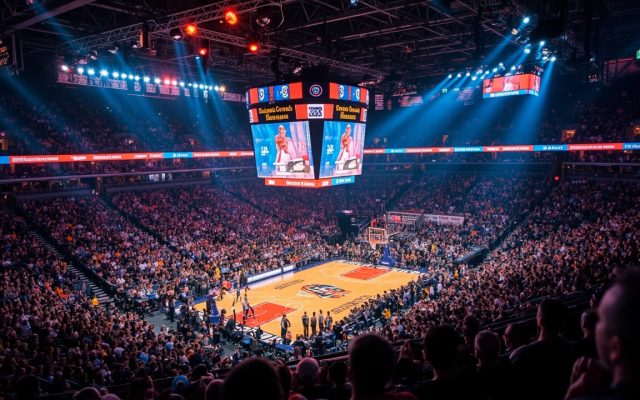
The Lakers play at crypto.com Arena in Los Angeles, one of the most prominent venues in American sports. The building sits at the center of a downtown entertainment district and has long served as a stage for major basketball moments, from regular-season showcase games to deep postseason runs.
Los Angeles is the perfect setting for a franchise with the Lakers’ identity. The city’s size, visibility, and cultural reach magnify everything the team does, whether the roster is built for immediate contention or for the next wave of development. The Lakers are not just a local team; they are a national and global attraction.
A quick look at the setting around the team helps explain the franchise’s scale:
- City: Los Angeles
- Conference: Western Conference
- Arena: crypto.com Arena
- Market identity: one of the league’s premier spotlight franchises
Last season
The Lakers’ 2025-26 season finished with a 53-29 regular-season record, a mark that reflected a successful campaign in the standings and kept the team in the West’s upper tier. In the playoffs, Los Angeles went 4-6 and reached the West Semifinals before the run ended with a Game 4 loss to the Oklahoma City Thunder, 115-110.
That outcome leaves the franchise with both encouragement and unfinished business. A strong regular season can still feel incomplete when it does not end in a conference finals appearance or a deeper run. For a team like the Lakers, the margin between a good season and a memorable one is usually defined by the postseason.
The next phase is about carrying the lessons from that run into a new year. The Lakers have enough talent to stay relevant again, but the pressure to turn regular-season success into postseason progress will always be part of the job in Los Angeles.
Current roster and coaching staff
JJ Redick is the current head coach, leading a roster that mixes established production, perimeter creation, defensive length, and developmental depth. The group is led by Luka Doncic and Austin Reaves, while several other rotation pieces and younger players give the team a wide range of lineup possibilities.
The roster also has clear size and guard depth, with contributors who can handle the ball, space the floor, protect the rim, and provide energy around the margins. The challenge for the coaching staff is to turn all of that into a cohesive team identity as the preseason schedule begins.
- JJ Redick — head coach.
- Luka Doncic, G, #77, age 27 — the team’s premier offensive engine; last season: 33.5 ppg, 7.7 rpg, 8.3 apg.
- Austin Reaves, G, #15, age 28 — a major all-around backcourt contributor; last season: 23.3 ppg, 4.7 rpg, 5.5 apg.
- Collin Sexton, G, #10, age 27 — a scoring guard with experience; last season: 15.4 ppg, 2.3 rpg, 3.3 apg.
- Walker Kessler, C, #14, age 25 — a frontcourt presence; last season: 14.4 ppg, 10.8 rpg, 3.0 apg.
- Quentin Grimes, G, #5, age 26 — a guard-wing option; last season: 13.4 ppg, 3.6 rpg, 3.3 apg.
- Sandro Mamukelashvili, F, #54, age 27 — a versatile forward; last season: 11.2 ppg, 4.9 rpg, 1.9 apg.
- Ziaire Williams, F, #11, age 25 — a wing contributor; last season: 10.2 ppg, 2.4 rpg, 1.1 apg.
- Jaden Hardy, G, #7, age 24 — a scoring guard; last season: 9.2 ppg, 1.5 rpg, 1.0 apg.
- Jake LaRavia, F, #12, age 24 — a forward with complementary production; last season: 8.2 ppg, 4.0 rpg, 1.8 apg.
- Cole Swider, F, #41, age 27 — a floor-spacing forward; last season: 5.9 ppg, 2.7 rpg, 0.3 apg.
- Matisse Thybulle, G, #26, age 29 — a defensive-minded guard; last season: 5.8 ppg, 2.0 rpg, 0.9 apg.
- Jarred Vanderbilt, F, #2, age 27 — a physical forward; last season: 4.4 ppg, 4.5 rpg, 1.3 apg.
- Dalton Knecht, F, #4, age 25 — a wing scorer; last season: 4.2 ppg, 1.4 rpg, 0.4 apg.
- Bronny James, G, #9, age 21 — a young guard prospect; last season: 2.9 ppg, 0.5 rpg, 1.2 apg.
- Kevon Looney, F, #55, age 30 — a veteran frontcourt piece; last season: 2.8 ppg, 5.6 rpg, 1.6 apg.
- Adou Thiero, F, #1, age 22 — a young forward; last season: 1.9 ppg, 1.1 rpg, 0.4 apg.
- Chris Manon, G, #30, age 24 — a backcourt depth option; last season: 0.8 ppg, 1.1 rpg, 0.3 apg.
- Cameron Carr, G, #43, age 21 — rookie guard.
- Arthur Kaluma, F, #47, age 24 — forward depth.
- William Kyle III, F, #45, age 22 — rookie forward.
- AK Okereke, F, #31, age 23 — rookie forward.
The preseason schedule begins with three early tests: Oct. 5 at the Sacramento Kings, Oct. 6 at the Golden State Warriors, and Oct. 8 against the Sacramento Kings. Those games offer the first look at how the roster fits together in a new year, especially under a new coaching voice and with so many players bringing different strengths to the table.
Rivalries
The Lakers’ history naturally feeds rivalries that carry weight beyond a single season. The most enduring ones come from the Western Conference, where repeated postseason meetings and high-stakes games have built familiar tension. Games against the Golden State Warriors and Sacramento Kings can still feel charged because of regional familiarity, competitive overlap, and the importance of conference positioning.
The strongest long-term Lakers rivalries, though, are tied to the franchise’s title-chasing identity. The team’s history includes legendary postseason battles with other NBA powers, and its place in the league’s biggest conversations often means that almost every important opponent becomes part of the storyline.
For the Lakers, rivalry is not just about geography. It is about expectations. A season in Los Angeles is usually framed by matchups that test whether the roster can handle pressure, handle attention, and handle the postseason standard that comes with wearing the purple and gold.
What to watch this season
The biggest storyline is how a roster with proven production and veteran experience comes together under JJ Redick. The Lakers have multiple players who can create offense, and the team’s challenge will be balancing usage, roles, and consistency while staying strong enough defensively to support a serious playoff push.
The second thing to watch is the frontcourt mix. Walker Kessler, Jarred Vanderbilt, Kevon Looney, and several forward options give the Lakers a variety of lineup choices, while Luka Doncic and Austin Reaves provide the kind of perimeter creation that can shape any offensive system. If those pieces complement one another, the team should remain a difficult matchup in the West.
Finally, the development arc matters. Players such as Dalton Knecht, Bronny James, Adou Thiero, Cameron Carr, William Kyle III, and AK Okereke add youth and long-term intrigue to the roster. For a franchise built on winning now, that blend of immediate ambition and future planning is part of the modern Lakers story.
Every season in Los Angeles starts with the same underlying question: can this group turn expectation into momentum? The franchise’s history says the answer always matters, and the current roster ensures it will be closely watched from the first preseason tip to the final spring game.